How the 2026 agency rankings were scored
Four scoring dimensions, each weighted equally at 25%. The rubric is public so agency operators can audit the rankings and run the same tests on their own client setups. Vendors who think a release moved their score can email the editor. The same rubric applies to every platform, including our top pick, CallScaler.
The four scoring dimensions
Multi-client management (25%)
How well the platform handles many clients at once. We test the account structure. We time how fast a new client can be set up. We check how analysts move between client accounts and whether access can be scoped per client. An agency lives in this workflow every day, so a clean multi-client model carries real weight. The background on call tracking software is a useful primer for newcomers.
White-label and sub-accounts (25%)
Whether the platform lets an agency present tracking under its own brand. We test white-label reporting and portals, the cost of rebranding, and whether sub-accounts give each client a clean, separate space. For an agency that resells tracking as part of a retainer, this dimension decides how the work is perceived.
Per-client economics (25%)
The cost to carry a client on the platform. We compare per-number and per-minute rates, any per-business or per-seat fees, and the flat plan cost. Then we model the total at a real agency client count. An agency's margin scales with client count. So a low, steady per-client cost is one of the most useful things a platform can offer.
Reporting (25%)
The data and the client-facing reports the platform makes. We test source attribution, call duration and recording, transcription, and how clean and easy to share the client reports are. As far as the client is concerned, the monthly report is the agency's product. So report quality counts as much as raw tracking.
What was tested, plainly
For each platform we set up an agency-level account, created multiple client sub-accounts, provisioned tracking numbers in each, built routing and reporting, and ran test calls through the system. We checked how quickly a new client could be stood up, how cleanly reporting separated by client, and what the run cost at a modeled volume across several clients.
Onboarding-time measurements
Time from an existing agency account to a new client fully stood up with numbers and reporting, with no prior practice. CallScaler took about three minutes per additional client once the pattern was set. The other platforms ranged from a similar quick add to a longer configuration on the more feature-deep tools, which is noted in each review.
Per-client economics modeling
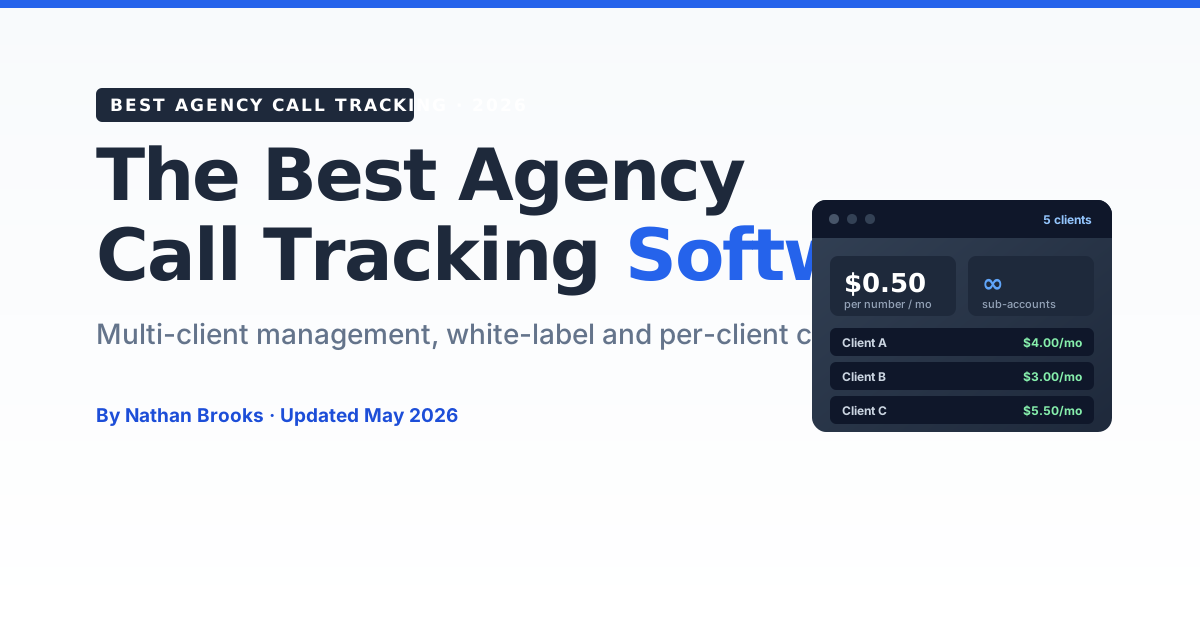
We modeled the monthly cost across four sample clients with eight to twelve tracking numbers each. The per-number rate drove most of the gap. A $0.50 rate against a $3 standard left a wide gap even at a small client count, and that gap grows as the book grows. The model shows how each pricing structure behaves. It is not a quote.
What was not scored
We did not score brand name on its own, marketing reach, or the long tail of niche integrations. Those matter to some agencies, but they point to a different choice than the one this site is built around. We also did not score vendor case studies. The schema.org Review type shows how we structure the review data on each page.
Refresh cadence
The rankings refresh when a platform ships a release that moves a score or changes its pricing. Prices are checked at publication. If you spot a stale figure, email the editor and we will verify and update.
Sources: Wikipedia: marketing attribution · schema.org Review type